All Categories
Featured

Scaling AI and ML Expertise Within Your GCC
Table of Contents

Modern GCC Strategies in North American Markets
The Global Capability Center (GCC) model has undergone a significant transformation as we move through 2026. What began as a method for cost reduction has matured into a sophisticated strategy for accessing high-tier talent and driving complex business functions. In the current 2026 environment, companies are moving away from traditional offshore locations in favor of centers located within North America. This change is driven by the need for real-time collaboration and a deeper understanding of local market nuances.
Operational centers in the region now handle tasks that were previously reserved for corporate headquarters. These tasks include advanced data analytics, proprietary software development, and specialized corporate operations. By placing these centers in nearby areas, organizations reduce the friction caused by significant time zone differences and cultural gaps that often plagued older offshore models. The 2026 approach emphasizes integration over isolation, treating the GCC as a core part of the business rather than a separate entity.
The labor market in 2026 has responded to this shift with a surge in specialized training programs. Workers are no longer looking for simple task-based roles. Instead, they seek positions that offer professional growth and the chance to work on high-impact projects. Many companies now focus on Global Capability Models to ensure their teams have the necessary tools to succeed in this competitive environment. This investment helps maintain a steady flow of talent even as competition for skilled professionals remains high across North America.
Labor Market Dynamics and Talent Acquisition in 2026
Finding the right people in local urban centers requires a different set of priorities than in previous years. Salary is no longer the only factor for top-tier candidates. In 2026, work-life balance, the quality of tech stacks, and the social responsibility of the employer carry significant weight. GCCs that adapt to these expectations find it much easier to retain staff, reducing the high turnover rates that often characterized the industry in the past.
The rise of specialized talent pools in the surrounding region has allowed GCCs to focus on niche areas. For instance, centers focusing on technical support have moved beyond basic troubleshooting to proactive system architecture and risk management. This evolution requires a workforce that is not just technically proficient but also possesses strong communication skills and business acumen. Recruiters are spending more time vetting candidates for these soft skills, recognizing that technical ability alone is not enough to thrive in a modern GCC.
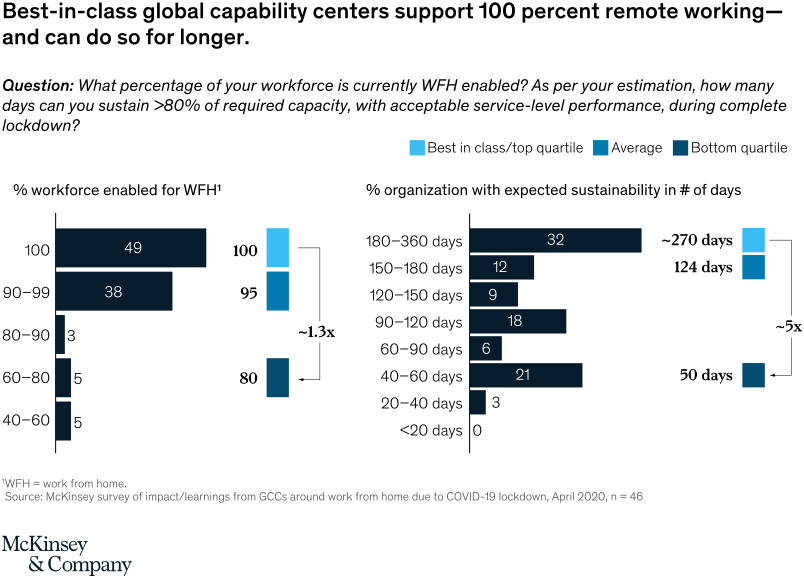
Remote and hybrid work arrangements have also stabilized. In 2026, the standard model for most GCCs involves a flexible approach that allows employees to balance office presence with home-based work. This flexibility has opened up the talent pool to include individuals living outside the immediate vicinity of the main office, provided they can occasionally commute for collaborative sessions. This geographic flexibility is a defining feature of the 2026 labor market, allowing firms to tap into talent that was previously unreachable.
The Economic Impact of GCCs in Local Regions
The establishment of a GCC brings significant economic activity to the local community. Beyond direct employment, these centers stimulate demand for local real estate, infrastructure, and secondary services. In 2026, many local governments have introduced incentives to attract GCCs, recognizing them as stable sources of high-paying jobs and long-term investment. These centers often anchor new business districts, encouraging other firms to move into the immediate area.
Investment in technology infrastructure is another byproduct of this movement. To support the high-speed data requirements of a 2026 GCC, many regions have upgraded their fiber-optic networks and power grids. The demand for Scalable Global Capability Models has pushed local providers to offer more competitive and reliable services. This improved infrastructure benefits the entire community, making the region more attractive to other industries and improving the overall quality of life for residents.
Standardized operational models have also helped streamline the setup process. In 2026, companies can establish a fully functional center in a fraction of the time it took just a few years ago. This speed is due to better access to local legal expertise, pre-built office spaces designed for tech-heavy operations, and a clearer understanding of the regulatory requirements in North American jurisdictions. This efficiency allows firms to react quickly to market changes, scaling their operations up or down as needed.
Technology and Automation within the 2026 GCC Model
Artificial intelligence and automation are no longer external tools used by GCCs. In 2026, these technologies are built directly into the operational DNA of the center. Teams in the surrounding area are responsible for training, maintaining, and refining the AI models that power the wider organization. This shift has changed the nature of many roles, moving away from manual data entry toward oversight and strategic management of automated systems.
Centers specializing in information technology are now leading the charge in cybersecurity and data privacy. With the increase in data sovereignty laws in 2026, having a GCC located within North America is a strategic advantage. It ensures that sensitive customer data stays within specific geographic boundaries, satisfying both legal requirements and consumer expectations for privacy. This focus on security has become a primary selling point for the North American GCC model.
Furthermore, the use of collaborative software has reached a new level of sophistication. Virtual reality and augmented reality tools are common in 2026, allowing teams in another location to feel as though they are in the same room as their colleagues in different cities. These tools have eliminated the "us versus them" mentality that sometimes hindered the performance of remote centers, creating a more unified corporate culture. Strong communication remains the most important factor in the success of these high-tech centers.
Regulatory Compliance and Operational Risk
Operating a GCC in 2026 involves navigating a complex web of regulations. Labor laws, tax codes, and data protection rules vary significantly between different provinces. Successful GCCs employ dedicated compliance teams to stay ahead of these changes, ensuring that the center remains a low-risk asset for the parent company. This proactive approach to risk management is a hallmark of the 2026 model, contrasting with the reactive strategies of the past.
Environmental, Social, and Governance (ESG) standards have also become a major focus. Companies are under pressure to ensure that their GCCs in the region operate sustainably. This includes using renewable energy sources, minimizing waste, and engaging in community development projects. In 2026, an organization's reputation is closely tied to the ethics of its global operations, making ESG compliance a business necessity rather than an optional add-on.
Management teams are also paying closer attention to political stability and economic health. While North America is generally stable, local fluctuations in specific markets can still impact operations. Diversifying GCC locations—perhaps by having a primary center in one metropolitan area and a smaller backup facility elsewhere—has become a common way to mitigate these risks. This multi-site strategy provides a safety net against localized disruptions, ensuring business continuity.
Future Outlook for GCCs in North America
As we look toward the end of 2026 and beyond, the GCC model will likely continue to evolve. The lines between "the business" and "the center" will continue to blur until they are indistinguishable. The focus will remain on high-value talent, technological integration, and geographic proximity. Organizations that successfully navigate the challenges of the local market will find themselves with a powerful engine for growth and innovation.
The success of these centers depends on their ability to stay adaptable. Markets change, technology advances, and worker expectations shift. The GCCs that thrive are those that view change as a constant and build their operations to be flexible. Whether it is a center dedicated to financial services or one focused on R&D, the core principles of 2026—integration, value, and talent—will remain the foundation of success. Continuous improvement is the only way to stay ahead in this fast-moving environment.
The transition to North American GCCs has proven to be a wise move for many firms. It has allowed them to reclaim control over their operations while still benefiting from the efficiencies of a centralized capability center. As more companies see the results of these investments in the surrounding region, the model will likely become the standard for any organization looking to scale its operations in 2026. The focus on quality over cost has finally become the dominant philosophy in the industry.

Table of Contents
Latest Posts

Anticipating Tech Stack Evolutions in 2026 GCC Models
Managing Multi-Jurisdictional Regulatory Requirements for Hubs

Cultural Sensitivity Training: A Pillar of Effective GCC Management
Latest Posts
Anticipating Tech Stack Evolutions in 2026 GCC Models
Managing Multi-Jurisdictional Regulatory Requirements for Hubs
Cultural Sensitivity Training: A Pillar of Effective GCC Management